
How to Read a Builder’s Quote: A Homeowner’s Guide
Starting to gather and compare builder’s quotes is a big step towards getting your new build, renovation or extension underway. But when you’re faced with page after page of unfamiliar terms and completely different totals, it can quickly get harder to know what you’re actually comparing.
This is why B4U Build recommends establishing your budget and project brief, then using it to check the scope, inclusions, exclusions, specifications and the assumptions behind each quote.
NOTE: This article provides general information only and is not legal or financial advice. Building and contract requirements differ throughout Australian states and territories. Always check the rules that apply where you live and seek independent advice before signing a building contract.
What Should a Builder’s Quote Include?
There isn’t one single template used for every builder’s quote. Some builders will provide an itemised breakdown, while others group construction costs under stages or different trades. What matters when you’re looking at a quote is identifying what has and hasn’t been priced.
Ideally, your builder’s quote should include clarification on:
- Builder, project and scope details.
- Supporting plans and specifications.
- Labour, materials, fixtures, fittings and finishes.
- Inclusions and exclusions.
- Prime cost items and provisional sums.
- Site costs and project assumptions.
- Builder’s margin, GST and total price.
- Quote validity, deposit and payments linked to project milestones.
Quote Terms to Know:
Builder’s Margin
The amount a builder adds to project costs to cover their overheads and to make a profit.
GST
The 10% goods and services tax applied to most goods and services in Australia.
A B4U Build estimate is an early budgeting guide, while the final building contract is the legally binding document that records the agreed work, price, terms and responsibilities.
For example, Consumer Affairs Victoria’s contract checklist says Victorian building contracts must include agreed work, plans and specifications. Each jurisdiction has their own requirements, so be sure to check to help you make an informed decision.
Industry Insight: Give Every Builder the Same Information

Jared Kemp
Building Manager and Director of RedKem Constructions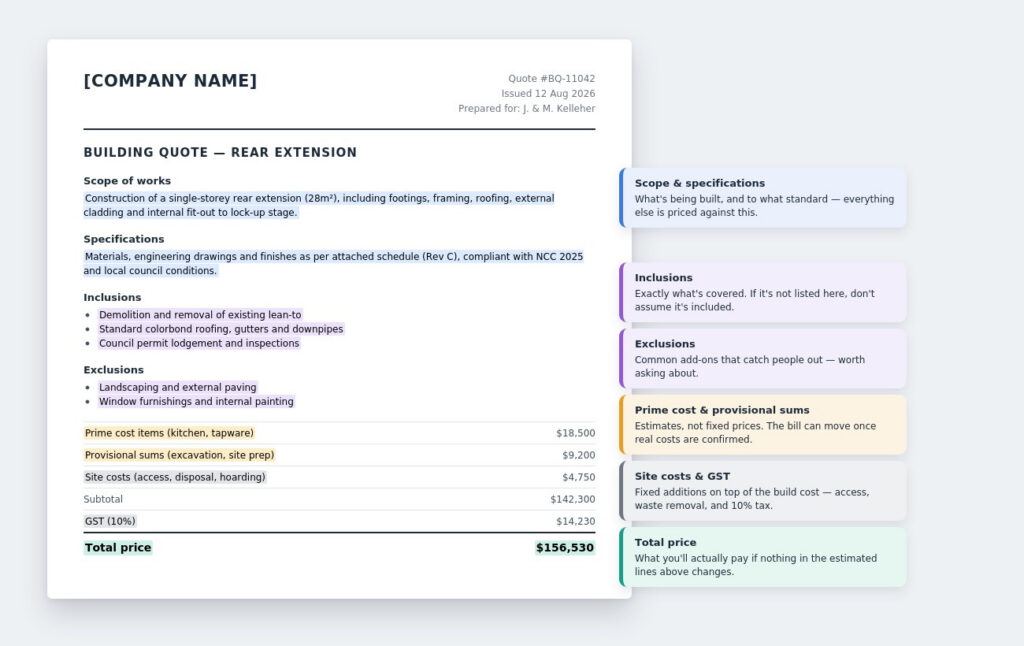
Start With the Scope of Works
Quote Terms to Know:
Scope of Works
The scope of works is the written description of what the builder has priced and agreed to complete.
When you’re reviewing a builder quote, make sure they have quoted the actual project requested. For a renovation or extension, does the scope cover demolition and structural alterations? Does a new build include the garage, driveway, retaining walls and outdoor areas discussed?
This is where B4U Build recommends a budget-first approach. Establishing the project scope and setting a realistic budget before requesting quotes means every builder works from the same information, making genuine price differences easier to identify.
To find out what’s been quoted, check each component against the supplied plans, specifications and brief. Also clarify any vague descriptions such as “standard electrical” or “site works as required” as this will help you more accurately compare quotes.
Check the Inclusions and Exclusions
You want to make sure you are clear on what’s included in the quoted price and what you’ll need to arrange and pay for separately to understand your true costs. Exclusions aren’t necessarily a concern as long as you know about it and you’ve allowed for them in your budget.
Inclusions
Depending on the new build, renovation, extension and builder, inclusions often cover:
- Fixtures and fittings.
- Flooring, tiling and painting.
- Appliances and cabinetry.
- Electrical, plumbing, heating and cooling.
- Site works and waste removal.
- Landscaping, fencing and external works.
If an inclusion seems too broad, it’s worth questioning the builder for more information. For example, if you see “appliances included” you also want to know the brand, model and allowance to allow you to compare fairly and accurately. Make sure you have this information for all tiles, cabinetry, tapware and other selections as there can be big differences in quality and allowances.
Exclusions
Some of the exclusions that are quite common include:
- Window furnishings.
- Landscaping.
- Utility connections.
- Specialist reports.
- Council fees.
- Work completed by other contractors.
Look out for phrases such as “by owner”, “not allowed for” and “subject to separate quotation” as they often mean something has not been included. If it is excluded, make sure you add it to your budget so you understand the quoted price versus total project cost.
Customer Experience: Working Out the Cost of a New Home

Katie Marshall
B4U Build CustomerUnderstand Prime Cost Items and Provisional Sums
On your quote and contract, you will notice items marked as or sections labelled as ‘prime costs’ or ‘provisional sums’. While they are both allowances, they cover different things.
| Prime Cost Item | Provisional Sum | |
| What it covers | Fixtures or fittings that haven’t been selected or priced yet. | Work that can’t be accurately priced yet. |
| Common examples | Tiles, taps and appliances. | Excavation and other site works. |
| Why the cost may change | Your final selection costs more or less than the allowance. | The work required costs more or less than estimated. |
Once the cost has been realised, it’s then compared with the allowance and either added or deducted from the contract price under relevant contract terms.
Separate changes to the agreed scope, selections or work after signing may be treated as contract variations and can also affect the final price. Your contract should outline how variations must be documented, approved and priced under your contract.
Industry Insight: Allowances are Not Automatic Gaps
Jared Kemp
Building Manager and Director of RedKem ConstructionsLook at the Allowances, Not Just Whether They’re Included
When you see “tiles included”, it’s easy to think it’s all sorted. But the allowance allocated for that item may be lower than what you expected, which may mean additional costs if you choose a more premium option. Keep this in mind for all the appliances, cabinetry, tapware and site work for your project.
If you notice these lines without detailed information, always ask and make note of:
- Is the allowance realistic for my preferred finish?
- Does it cover supply only, or supply and installation?
- Are quantities and GST included?
- What happens if the actual cost is higher or lower?
- Are competing builders using similar allowances.
Industry Insight: An Inclusion Can Still Change the Price
Jared Kemp
Building Manager and Director of RedKem ConstructionsCheck for Site Costs and Project-Specific Assumptions
Site conditions aren’t always what they seem, which can alter the price even before your construction work begins. In B4U Build’s 2026 house-building guide, it’s estimated that site preparation and earthworks account for around $10,000 to $45,000 of a project, so that impact can be big.
This is why you want to make sure your quote covers, at the very minimum:
- Excavation and demolition costs.
- Soil conditions and foundation requirements.
- Site access for machinery and deliveries.
- Temporary works.
- Engineering scope.
- Utility connections.
- Relevant approval costs.
But it’s not just enough to have these factors quoted. To reduce the chance of them impacting the end price you pay, you want them to be based on soil reports, surveys or engineering information. If they’ve been made based on the builder’s assumptions about the soil stability, foundations, access or existing services, that’s when changes can push timelines and impact your original quote.
Why Are Two Builder Quotes So Different?
The major differences between builder quotes can start before either builder calculates a price. If each builder receives different plans, specifications or project details, they’re already looking at different versions of the same home, which can impact the price. Starting with a consistent scope and brief won’t make the quote identical, but it will make it easier to identify why there are differences in prices.
Builders may also use different materials as a standard inclusion or have different overheads, subcontractor rates, labour costs and margins. These differences aren’t automatically red flags. If two builders have allowed for different site conditions, they’re not pricing the same version of the project, which can explain a large gap in their quotes.
For example, you may receive a quote from one builder who quotes standard finishes with minimum inclusions, while another may include premium selections, painting, permits and external works. This would show a big difference in the quote.
Industry Insight: Price Comes After Scope
Jared Kemp
Building Manager and Director of RedKem ConstructionsHow to Compare Builder Quotes Properly
When you sit down to compare builder quotes, line each one up beside the plans, specifications and project brief. This becomes a baseline for your comparison tools, helping you check each quote against the same version of your project rather than judging the quotes against each other alone. Then, work through them in the same order, making note of:
- If each builder has priced the exact same scope.
- The materials, fixtures, fittings and finish levels.
- The exclusions and estimate their effect on the project budget.
- Each prime cost and provisional sum.
- Any unconfirmed site costs and assumptions.
- Any vague or missing information in writing.
As well as the price, make sure you consider the experience, communication and project suitability of each builder, as this can make a big difference in your experience.
How a Cheaper Builder’s Quote Can Cost More in the End
Choosing the cheaper builder quote can cost more in the end if it excludes important work or uses lower allowances for items that are likely to cost more. For example:
| Quote A | Quote B | |
| Headline price | $410,000 | $445,000 |
| Flooring | Excluded | Included |
| Kitchen allowance | $15,000 | $28,000 |
| Excavation | $8,000 provisional sum | $18,000 provisional sum |
| Painting | Owner to arrange | Included |
At first glance, Quote A is the lower priced quote at $35,000. On closer look, it excludes flooring, painting and uses smaller allowances. It doesn’t mean it’s not good value, however it can’t be fairly compared with Quote B until those differences have been calculated.
This example is illustrative only.
Focusing on inclusions while overlooking what’s been left out is one of the most common builder quote mistakes. Make sure you always price each exclusion before deciding which quote offers better value.
Questions to Ask Before Accepting a Builder’s Quote
Before moving forward based on a building estimate, quote or contract, ask:
- What isn’t included in this price?
- Which costs are allowances rather than fixed amounts?
- What selections or decisions could change the price?
- Are there any site costs that haven’t been confirmed?
- What plans and specifications has the quote been based on?
- How long is the quote valid?
- What happens next if I want to proceed?
- Is there an upfront fee or preliminary agreement for the next stage?
Residential building quotes are often valid for around 14 to 30 days, although this period should be clearly stated on the quote. If it expires, ask the builder to review and reissue or extend it in writing, as pricing, material availability and proposed timing may have changed.
A reputable builder should happily clarify any vague allowances, exclusions or assumptions. Some builders may also provide an initial quote without charging, while detailed estimates or preliminary services may involve a fee. It’s best to confirm the cost and deliverables first.
There is no single most expensive part of every build. Labour, materials, site work, structural complexity, kitchens, bathrooms and finishes can all drive costs in their own ways.
Know Your Budget Before You Ask Builders to Quote
Comparing quotes becomes harder when the project isn’t clearly defined. When you give builders different information, each will price different versions of the home, renovation or extension.
B4U Build’s building cost estimator helps establish a realistic project budget. Simply enter your project type, site details, spaces and finish level, then download a brief to give builders and designers the same starting information.
Customer Experience: Checking the Budget Before Design
Peter D used B4U Build to establish an early project price before entering the design phase or approaching a builder.

Peter D
B4U Build CustomerMore than 15,000 Australian homeowners have now used B4U Build to help plan a new home, renovation or extension. See how B4U Build works or review some of our most frequently asked questions about building renovation costs for more information.
A B4U Build estimate is a budgeting tool, not a fixed quote or substitute for project-specific pricing. It gives you clarity before commissioning detailed plans.
Get your B4U Build estimate and know your budget before you start comparing builder quotes.