
How Long Does It Take to Build a House?
If you’re researching how long it takes to build a house in Australia, the answer itself can be confusing. In short, it may take 10 months or it might take 2+ years. Even the final handover date in your contract is a guide only, which can still be affected by delays, preventable or not.
This variation in timelines is why B4U Build recommends taking the time to understand how project timelines work and what can impact their progress before moving forward with a new home or renovation.
B4U Build Insight:
“Every build has several clocks running at once. Approvals, builder availability, material lead times and client decisions all have their own timelines, with each having potential to hold up the next and estimated handover date.”

Jared Kemp
Founder of B4U Build and multi-award-winning professional builderWhat Is the Average Time to Build a House in Australia?
According to recent national data from the Australian Bureau of Statistics, homes throughout the country took approximately 10.4 months to be built between 2023–2024. However, this figure only measures the average physical construction timeline, and does not consider design, documentation, approvals and home builder selection.
The type of home you build may also affect the timeline:
| Build type | How it may affect timing |
| Standard project home | Any changes to plans, specialised materials or non-standard selections may impact the schedule. |
| Custom home | Individual home design details, custom selections and specialist trades may require a longer build time. |
| Knockdown rebuild | Demolition, service disconnections and additional site preparation can impact timelines before construction. |
| Complex architectural home | Detailed engineering, non-standard materials and difficult site conditions can all extend multiple stages. |
This is why two near-identical looking homes that start their build on the same day may end up finishing days, weeks or even months apart. Understanding the main stages of the building process can guide you on what to expect and how your plans, site conditions, selections and builder’s current schedule may impact different steps.
The Main Stages of Building a House
The total time to build a house is spread across multiple connected stages, each with their own timelines. If there are delays early in the project, it can also affect the later stages, pushing the handover date out if the specifics are not properly considered.
Design, Documentation and Approvals
The first stage of the home build is creating your house design and turning into detailed, buildable plans. Depending on the type of property and what’s involved, it may include:
- Site surveys and soil testing.
- Concept plans and working drawings.
- Structural engineering.
- Energy assessments.
- Material and finish specifications.
- Planning approval and attaining a building permit.
At this stage, trades won’t need to be rescheduled, but any missing details or revision requests can hold up the approvals, quoting and start dates. Every state and region also has different requirements, so it’s important to check with your relevant council or certifier to help prevent delays.
B4U Build Customer Experience: Assessing Borrowing Capacity Before Design
By using B4U Build, homeowner Peter was able to start conversations with his bank before the design stage to help create a smooth process that didn’t impact his build timeline.

Peter D
HomeownerBuilder Selection and Pre-Construction
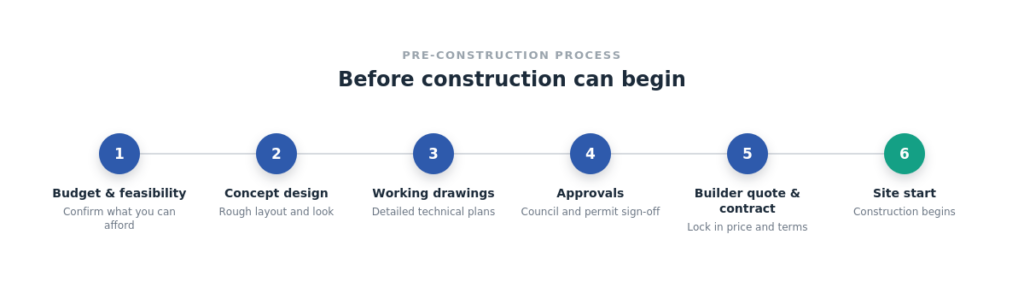
With the scope sufficiently detailed, you can then provide the plans to a shortlist of builders so they can inspect the property and prepare quotes. Taking time to understand the builder’s quotes, as well as comparing the experience and availability of the building companies takes time, which is a stage all in itself.
Don’t rush choosing the right builder. This decision can have a lot to do with being able to stick to a realistic construction schedule later.
Before a start date can be confirmed, you’ll also need to look at:
- Locking in finance approval or pre-approval.
- Completing contracts and any insurance.
- Confirming major selections.
- Ordering long-lead materials, if relevant.
- Making sure required approvals are in place.
Site Preparation and Foundations
Before construction can begin, the site needs to be prepared. The site work involved depends on the project itself, each with their own potential setbacks, such as:
| Site work | When it may be required |
| Demolition | For knockdown rebuild or sites with existing structures. |
| Clearing and excavation | To clear vegetation or prepare uneven ground. |
| Retaining and drainage | For sloping blocks or sites that require water management. |
| Service connections | Where new water, power or communications infrastructure is required. |
| Additional engineering | Where there are reactive soil, rock or difficult ground conditions. |
B4U Build Insight:
“There are some stages that are harder to put a firm timeframe around than others, especially when they rely on other parties. For example, a soil test can take three to four weeks to come back, while unexpected rock, reactive soil or restricted access can add more work before the slab is even poured. Ask the council if a soil test is already on record so you can get an early understanding of the site to provide to builders.”
Jared Kemp
Founder of B4U Build and multi-award-winning professional builderFrame and Lock-Up
There are two distinct milestones in a new home build:
- Frame stage, where the walls, roof trusses and main structural components are installed.
- Lock-up stage, where roofing, external cladding, windows and external doors enclose the home.
Because the frame, roofing and windows must arrive and installed in the correct order, a delay in one can a domino effect other trades from being able to start. This alone can cause a setback, which can also be further delayed by trades availability.
The Australian Bureau of Statistics reported in 2026 that skilled labour availability remained an ongoing challenge for residential builders. This is one of the reasons why builder selection is important, making sure they have a network of reliable carpenters, bricklayers and concreters to help minimise construction delays.
Fit-Out and Finishes
Once the home has reached lock-up stage, internal trades can start working through the connecting sequences:
- Plumbing and electrician rough-in.
- Insulation and internal wall linings.
- Waterproofing and tiling.
- Cabinetry and internal joinery.
- Painting and flooring.
- Electrical, plumbing and appliance fit-outs.
All it takes is for one trade to be delayed to impact the next one. For example, if the kitchen cabinetry gets held up and doesn’t arrive on time, the cabinet market can’t start on time. The stonemason then can’t measure or install the benchtop, the plumber can’t connect the sink and tapeware, and the electrician can’t start on the cookware and final power points.
Making sure your own decisions are always on-time will help keep things on-track.
B4U Build Insight:
“The frame can make it feel like your house has gone up overnight. The next stage is when all the different roofing, window, brickwork, inspection and other trades start lining up, so it’s often when progress can look slower even when the schedule is still moving.”
Jared Kemp
Founder of B4U Build and multi-award-winning professional builder
Practical Completion and Handover
When the home is nearing completion, yourself as the homeowner and the builder will conduct a walk-through inspection. This is where you can point out any defects or corrections, which will be noted for the builder for rectification, which may push back the handover. The relevant building certifier or surveyor will also conduct separate inspections to make sure the home is completed to a high standard.
Keep a buffer between the expected construction finish and moving day to allow time for these final checks, re-inspections and the handover arrangements.
What Can Affect How Long It Takes to Build a House?
While the average build time for a house is a useful starting point, it can’t account for every condition that may impact a specific project.
Some of the most common factors that can cause delays include:
| Factor | How it can affect the build timeline |
| Home size and complexity | Where larger floor plans, multiple levels, curved details, voids, custom joinery and specialised finishes require more labour and coordination. |
| Site conditions | If the presence of sloping land, limited access, reactive soil, rock, flood requirements, retaining walls or existing structures add work before the main build can progress. |
| Approvals | Any hold-ups with planning requirements, building certification, engineering changes and requests for more information delaying the intended start date. |
| Weather | Excavation, concrete pouring, framing, roofing or external work interrupted by heavy rain, extreme heat, storms and wet ground. |
| Trade availability | If a key subcontractor is unavailable requiring connecting tasks to be rescheduled. |
| Material availability | Installation delays caused by long lead times, transport disruptions or discontinued products. |
| Design changes and variations | Changes requiring revised pricing, documentation, engineering, approval, ordering and rescheduling. |
| Decision delays | Procurement and work delays caused by late selections. |
How to Avoid Unnecessary Building Delays
Even the best planned process can’t remove every single possible delay. However, being prepared can help reduce preventable interruptions and give you greater confidence around the timeline, including:
- Setting a realistic budget early so the design remains achievable within your limits without major revisions later.
- Finalise important design decisions before construction and avoid changing completed work.
- Use detailed plans and specifications so builders can price, order and schedule accurately.
- Make selections by the required dates, allowing extra time for products with long lead times.
- Limit variations during construction, as they may affect approvals, orders and multiple trades.
B4U Build Insight:
“One late decision can affect several trades. A delay in a single material may not seem like the biggest setback, but it can delay one trade to start, which can cause the trades waiting on their work to be finalised to be rescheduled. Everything overlaps in a build.”
Jared Kemp
Founder of B4U Build and multi-award-winning professional builderPlanning Your Build Before Construction Begins
Having a clear budget and project scope from the start can help keep the design, quoting and construction stages all moving in the right direction.
It’s at this stage before you commit to a designer or builder that B4U Build is designed to help you navigate, when your likely budget range can shape better decisions. B4U Build’s home building cost estimator lets you test different room configurations, site details and finish levels before committing to detailed plans and getting onto a timeline. See how B4U Build works and download a project brief to share with designers and builders.
B4U Build Customer Experience
Danielle Goninan
HomeownerUsed by more than 15,000 Australian homeowners, B4U Build provides an early budgeting guide rather than a fixed builder quote. Planning a new home? Get your building estimate before you progress too far into the design.